The Gender Competence Framework™
A framework by Pamela Kiambi, building on the established concept of gender competence. It sets out five dimensions that, together, describe what competent gender practice actually looks like, and a practical system for assessing and building it in individuals and organisations.
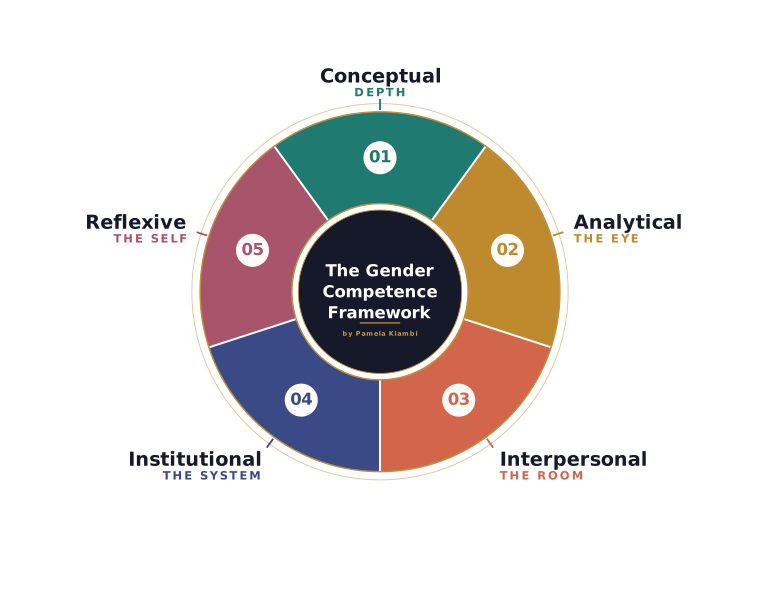
Conceptual Competence
DepthUnderstanding gender frameworks deeply, not just their definitions. Knowing the difference between an instrumentalist “smart economics” framing and a rights-based one, and why it changes what a programme targets.
In practice: you can explain a concept to a non-specialist, engage the contested debates, and notice when a policy reduces “empowerment” to access alone.
Analytical Competence
The EyeApplying a gender lens to real situations, documents, and decisions. Seeing past a 60% participation headline to ask who controls the income, who sits on the committee, and whose time is assumed to be free.
In practice: you read budgets and results frameworks critically, and connect analysis to concrete recommendations.
Interpersonal Competence
The RoomNavigating conversations, resistance, and the emotional charge of the work. Holding your ground when data is dismissed in public, and moving a room without making anyone wrong in front of their peers.
In practice: you facilitate difficult dialogue, work with resistance rather than against it, and sustain yourself through the emotional demands.
Institutional Competence
The SystemUnderstanding how organisations enable or undermine gender work. Knowing who really makes decisions, building allies before the meeting, and framing the gender case in the register, values, evidence, or risk, that fits the audience.
In practice: you turn a results-framework annex into core indicators, and protect a gender post by tying it to donor markers and audit exposure.
Reflexive Competence
The SelfExamining your own positionality, assumptions, and blind spots. Treating the moments your instinct clashes with what people tell you as data worth following, and letting a colleague’s challenge change your defaults.
In practice: it runs underneath the other four and keeps them honest. A weekly reflective habit is how it grows.
Where the framework earns its keep
Programming
Move from gender-aware language to gender-responsive design, where the intervention changes who decides, not just who attends.
Monitoring & Evaluation
Choose indicators that detect real change, decision-making, time-use, control of resources, rather than counting heads.
Mainstreaming
Embed gender across strategy and systems by understanding how the institution actually decides, and where leverage lives.
Individuals build capability. Organisations build defaults.
The five dimensions describe competence in a person. Gender work, though, is carried by organisations too, and what an organisation can do depends less on any one person than on what it does when nobody makes a special effort. The maturity scale measures how far the work has become automatic.
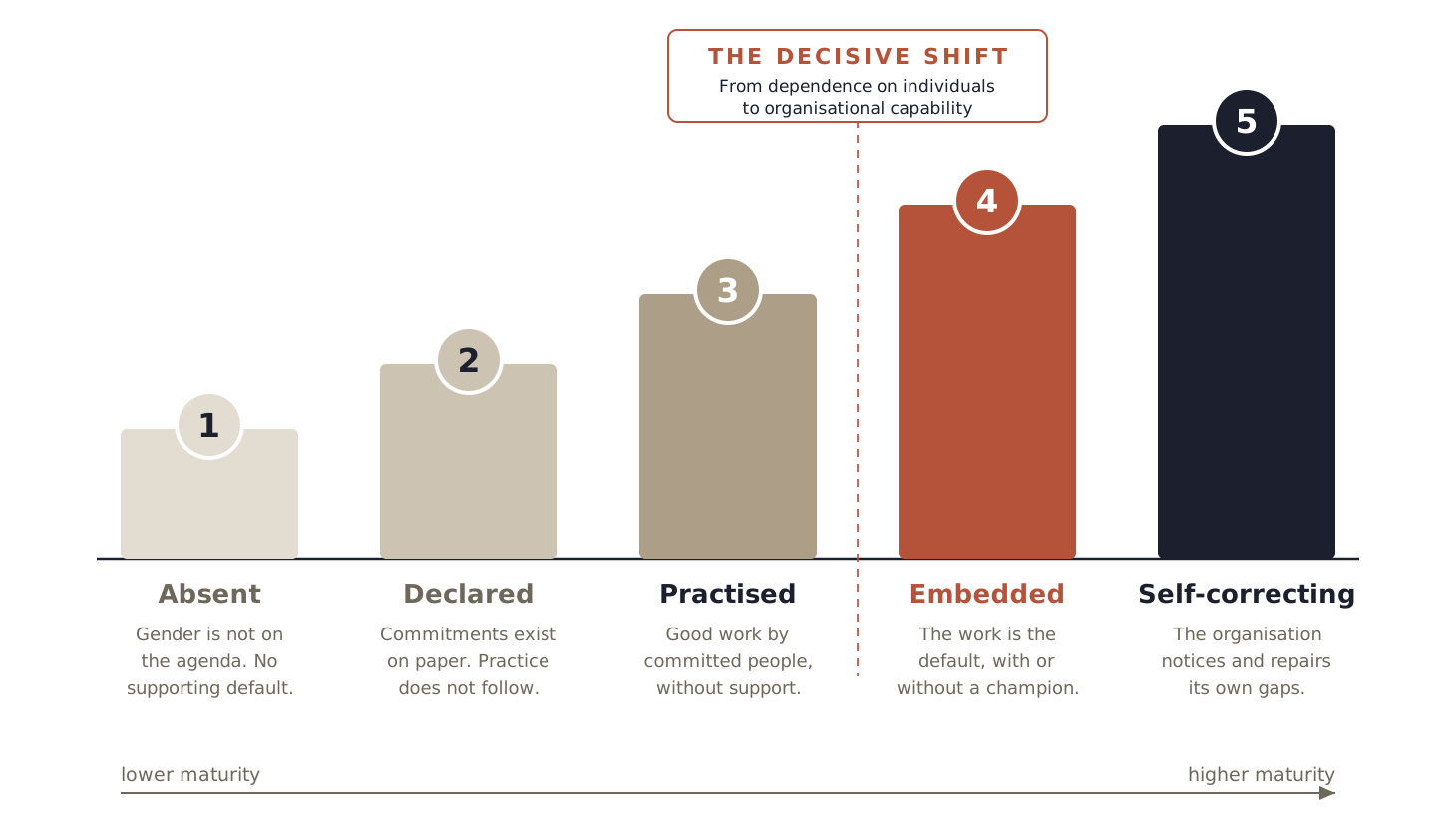
The gap between the third and fourth levels is the most consequential in the framework. Most organisations that call themselves strong on gender are Practised, committed people doing good work without the organisation behind them. That is not competence but dependence, and it is one resignation away from slipping back.
A five-dimensional framework for assessing, developing, and applying gender competence.
Kiambi, P. (2026). The Gender Competence Framework: A five-dimensional framework for assessing, developing, and applying gender competence. (Version 1.0). GenderWork Simplified. https://doi.org/10.5281/zenodo.21661305
Frequently asked
How is gender competence different from gender awareness?+
Awareness is a cognitive state, recognising that gender relations exist and matter. Competence is a demonstrated capability, the ability to apply that understanding to real professional decisions, under pressure, with results that hold. Much of why gender commitments fail to reach practice sits in the gap between the two.
Why five dimensions rather than a single measure?+
Because gender competence is composite, not singular. A person can be strong in one dimension and absent in another, and a team can hold four and be missing the fifth. A single total score would hide exactly the information the framework exists to reveal, so it produces a profile instead, and the shape of that profile is the finding.
Can an individual be fully gender competent on their own?+
Rarely, and they do not need to be. No one person needs all five dimensions at the highest level; teams and organisations hold them collectively. Reflexive competence is the exception, since the assumptions in question are each person’s own and cannot be delegated.
What is the difference between individual capability and organisational maturity?+
They are separate measures. An individual builds capability across the five dimensions. An organisation builds defaults, what it does when nobody makes a special effort. Good work resting on a few committed people can look strong yet be fragile, since it is one departure away from stopping. The goal is capability embedded in the system itself.
Who is the framework for?+
The framework is for practitioners, teams, and organisations that want to strengthen how gender work is carried out in practice. Whether you work in an NGO, government, a UN agency, a donor organisation, consultancy, or research institution, it provides a structured way to understand, assess, and develop gender competence.
How was the framework developed?+
It emerged from professional practice, close observation, and engagement with the literature on gender, organisations, and professional competence. It draws on competence theory, organisational theory, capacity development, and adult learning, and names what practitioners who close the awareness to practice gap were already doing without a shared language for it.